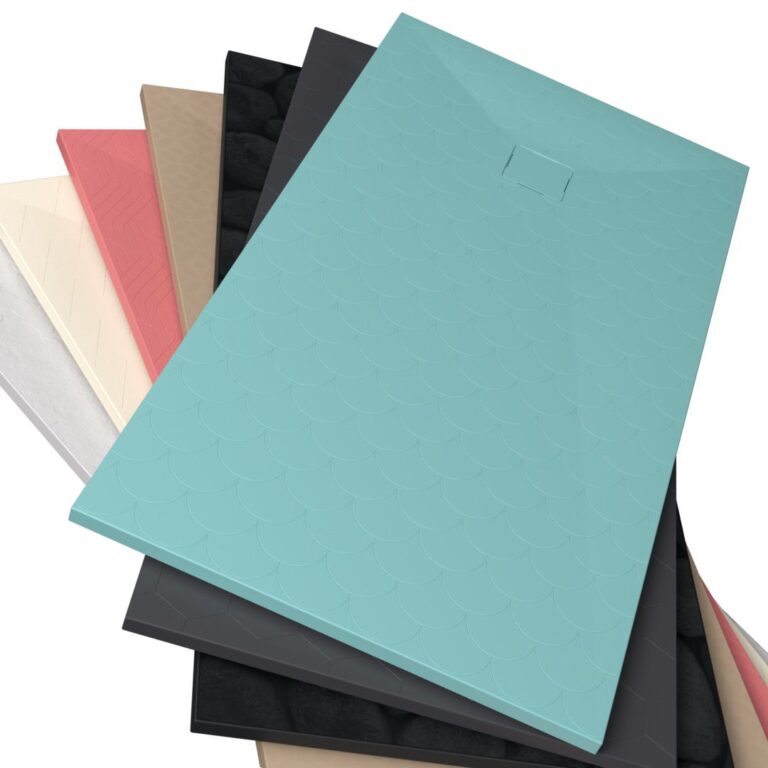

In the sanitaryware sector, shower trays manufactured with polyester resin and conventional mineral fillers (such as dolomite or calcium carbonate) offer a high-quality surface finish and a warm touch. However, they present a major technical drawback with a high economic impact: their heavy weight. A standard large-format shower tray can easily exceed 50-60 kg, which raises export freight costs, complicates pallet transport, and requires two workers for handling and site installation. Large retailers and distributors increasingly demand lighter shower trays that a single person can handle. Reducing shower tray weight without losing performance has therefore become a clear competitive advantage.
Attempting to reduce this weight by adding untreated fillers or using resins with a very low exothermic peak usually leads to severe issues in the factory and at the end customer’s home: corner deformation, excessive flexibility, and failures in physical-mechanical strength tests. The technical solution does not lie in subtracting raw materials from the mold, but in implementing Light Weight Filler (LWF) technology.
How to reduce the weight of a resin shower tray using the right mineral filler
LWF technology replaces the traditional dense mineral fraction with a balanced formulation of treated minerals that generate a lower-density polymerized mass. While a conventionally manufactured mineral filler shower tray has a density of around 2.3 kg/litre, incorporating our light weight mineral fillers allows manufacturing parts with densities around 1.2 kg/litre, representing up to 40% less total weight.
Gelcoat, Anti-slip properties and Certification
Because the density reduction is achieved through a microbubble structure, the shower tray must be coated with a gelcoat. For this technology, we have developed high-performance ISO-NPG gelcoats offering the complete RAL color chart, various textures and finishes, and the most demanding anti-slip resistance classes required for this product type. Shower trays manufactured with this technology pass demanding certification tests in accredited independent laboratories according to applicable European CE marking standards (ISO EN 14527) and British standards (UKCA) — in most cases recording deformations of less than 1-2 mm. By controlling the exothermic peak and ensuring complete wetting in the area next to the gelcoat, air micro-voids are eliminated and the risk of chipping or delamination from osmosis is reduced to zero.
Advantages of manufacturing low weight shower trays
- Lower freight costs: weighing significantly less, more shower trays fit into each truck or container, reducing the unit shipping cost and making exports more competitive.
- Single-person installation: A lightweight tray is handled and installed much more easily, an increasingly common requirement in large-scale retail.
- Higher productivity: by injecting a less dense mass into the mold, you produce more trays per day (up to 15-20% more) without changing the workflow.
- No line changes required: the technology is implemented immediately on existing production lines, with no additional investment in machinery.
How to Transition Your Shower Tray Production to Light Weight
Migrating from a dolomite formula to a light weight filler is straightforward: most manufacturers adapt their current production line without investing in new machinery. Our technical department helps you define the optimal target density —the balance between weight and cost— and supplies test samples for your own line. If you want to test the technology on your shower trays, just get in touch with us.
Frequently asked questions about low weight shower trays
How much can a low weight shower tray weigh?
It depends on the dimensions and the target density, but weight reduction reaches up to 40%. For example, a 1200 × 900 mm shower tray can go from around 38.5 kg with dolomite to around 28.5 kg with a light weight filler.
Is it necessary to apply gelcoat on a light weight shower tray?
Yes, it is essential. The density reduction is achieved by creating an internal microbubble structure within the polymerized mass, so the outer layer must be sealed with a gelcoat providing chemical resistance, surface hardness, the desired RAL colour and the required anti-slip properties. For this technology we have developed high-performance ISO-NPG gelcoats, with various textures and finishes, and the most demanding slip-resistance classes.
Does the shower tray warp when reducing its mass?
No, provided the formulation is chemically balanced. Silanized surface treatment and the formulation of our mineral fillers keep the mass homogeneous during curing, ensuring perfect planar rigidity.
Are mechanical performance or impact resistance lost?
No. Independent laboratory tests conducted by our customers prove that the physical-mechanical properties of a shower tray lightened with LWF technology are equivalent to or even higher than those manufactured with standard dolomite or calcium carbonate fillers.
Do I need to change my production line to manufacture them?
No. It is an immediate-implementation technology on existing lines, with zero additional investment in machinery.
How does weight reduction affect the final cost of the shower tray?
Although light weight filler has a higher unit cost per kilo than raw dolomite, the savings from using fewer kilos of filler per part, resin savings per part, transporting more shower trays per shipment, increased unit plant productivity, and reduced repair rates far outweigh it, lowering the total cost per manufactured tray.
Discover All Light Weight Filler Technology (LWF)
At AITANACHEM we place our technical laboratory at your disposal to analyse your current formulations, adjust your line’s target density and send you test samples with no obligation. To assess weight reduction in your resin shower trays, get in touch with us.
Shower tray weight reduction is just one of the applications of our loght weight technology. Discover all technical details on our light weight mineral fillers page and, if you want to explore our full range, consult the complete guide on mineral fillers.