
If you manufacture countertops, shower trays or washbasins, you know the scene: the part comes out of the mould flawless, gets installed, and a few months later comes the customer call regarding marks and scratches around the sink. Scratching, along with staining, is a primary reason for customer complaints in solid surface materials—and it is also the main argument quartz competitors use to capture kitchen countertop market share. The good news is that this problem has a definitive technical solution. The answer lies not in changing the resin system, but in optimizing the mineral filler.
In this article, we explain why solid surface scratches, how scratch resistance is measured, and exactly what you get by implementing our new high scratch resistance technology for solid surface products.
Why solid surface scratches
A solid surface part consists, putting it very simply, of two main things: a polymer matrix and a mineral filler. The matrix (acrylic or ISO NPG polyester) provides cohesion, appearance, colour and that repairability which makes the material unique. The filler provides body, dimensional stability and, above all, surface hardness. And here is the key: the mineral filler accounts for around 60-70 % of the total weight of the part. When an object rubs across a countertop, you are not touching resin; but essentially, mineral surrounded by resin. If that mineral is soft, the part is soft. However good the resin may be.
Conventional aluminium trihydrate (ATH), the standard filler used to produce solid surface parts, is a relatively soft mineral. While standard ATH filler provides excellent whiteness and enables easy sanding and polishing, it is not formulated to resist aggressive scratching from everyday metal objects. End consumers, however, expect long-term durability without needing to sand down their solid surface countertop every few months.
The Mohs scale: where your part stands today
Scratch hardness is measured on the Mohs scale, ranging from 1 (talc) to 10 (diamond). A material scratches anything below its rating and is scratched by anything above it. It is a simple scale. That is why it is the one the industry uses.
| Material | Approx. Mohs Hardness |
|---|---|
| Fingernail | 2,5 |
| Conventional solid surface (ATH standard) It gets scratched | 2,5 – 3 |
| Euro coin | 4 – 4,5 |
| Steel knife | 5,5 |
| Glass | 5,5 – 6 |
| Solid surface with anti-scratch filler technology | 6 |
| Quartz | 7 |
If you look at the table above, you will see the problem straight away: a coin is harder than a conventional solid surface countertop. That is why it scratches it. That is why a key, a knife or the edge of a pan does too.
Elevating the hardness if a solid surface countertop to Mohs 6 scale places it above coins and steel knives, bringing it to the level of glass. In daily use, the surface stops scratching against common kitchen utensils.
The coin test: Convince yourself in 60 seconds
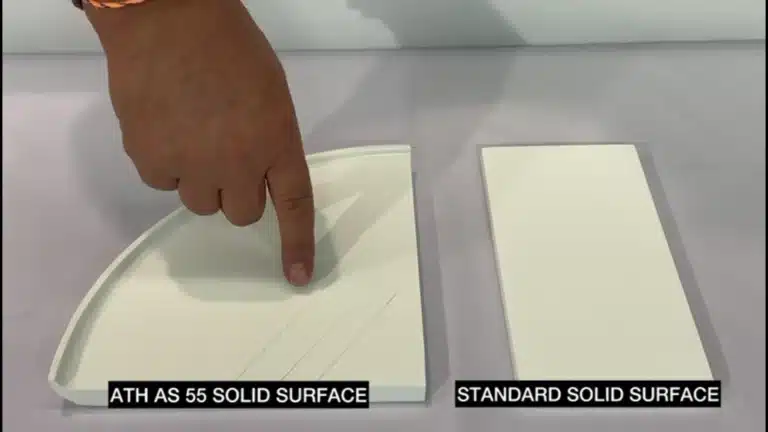
Seeing the material performance under direct friction provides clear proof. In this video from our YouTube channel, we compare two solid surface parts: one manufactured with our ATH AS 55 anti-scratch filler and another produced with a standard ATH. Both undergo a friction test using a euro coin.
What happens in each case is the opposite of what it looks like at first glance. On the standard solid surface part, the coin is harder than the material: under pressure, the coin digs in and scratches the surface easily, leaving permanent damage that requires mechanical sanding.
On the solid surface part manufactured with our ATH AS 55 technology, the opposite happens. The part is harder than the coin. Because of that, the coin acts like a pencil, leaving a superficial metallic trace on top of the part. This metal trace wipes off effortlessly with a cloth, leaving the underlying surface completely intact.
Achieving a hardness of Mohs 6 (similar to steel) makes this technology ideal for high-wear applications like kitchen countertops and sinks.
The solution lies in the filler, not just the resin
While manufacturers often attempt to increase surface hardness by upgrading to higher-grade ISO NPG resins, resin alone cannot overcome the physical limits of a formulation containing 60–70% mineral filler. Replacing standard mineral fillers with specialized functional fillers is the direct path to improving scratch resistance in solid surface products.
We currently have two types of filler, depending on the colour of the finished part:
ATH AS 55: for white solid surface
ATH AS 55 is a specialized mineral mix with high chemical resistance developed to enhance surface hardness, scratch resistance, and abrasion performance in solid surface, polymer concrete, and engineered stone.
- High Whiteness: Typical whiteness is 93, allowing manufacturers to gain surface hardness without compromising brightness or color purity.
- Non-Crystalline Silica: The silica content in ATH AS 55 is strictly non-crystalline. This avoids occupational health hazards associated with respirable crystalline silica and provides a compliant solution for markets placing strict regulations on traditional silica quartz countertops.
Hematite 70: for black solid surface
Black colour accentuates surface marks and scratches. It is also the colour most in demand for designer countertops and sinks. Hematite 70 is a black mineral pigment filler engineered specifically for dark solid surface formulations.
In addition to Mohs hardness performance, Hematite 70 offers very high UV radiation resistance, making it suitable for exterior applications such as facade cladding and outdoor furniture without colour shifting over time.
Technical assistance and custom formulations for your project
At AITANA CHEMICALS, we go beyond supplying high-performance raw materials. We specialize in custom mineral blends, adjusting particle size distribution (granulometry), whiteness, density, and flame retardancy to align with your specific mechanical requirements and cost targets. It is what we have been doing for years with our mineral fillers for composites.
Integrating new filler technologies into existing manufacturing lines requires careful formulation balancing. That is why we offer a complete technical assistance service. Our technical team provides end-to-end support, assisting on-site with resin selection, viscosity adjustment, and full process implementation to ensure seamless adoption in your plant. Our goal is to make sure your solid surface products reach the performance and quality levels your market demands.
Frequently asked questions (FAQ) on solid surface scratch resistance
Do I need to modify my production line or purchase new equipment?
No. Our anti-scratch fillers can be implemented immediately on existing solid surface production lines without additional machinery investments. We simply adjust the formulation parameters to suit your current equipment if necessary.
What commercial advantages does this technology provide?
It allows you to position your products in the premium segment with mechanical properties far exceeding standard solid surface. Additionally, in markets where quartz countertops face health or import restrictions, it enables you to offer a safe, silica-compliant alternative with steel-like scratch resistance (Mohs 6).
Are metallic marks easy to clean off the surface?
Yes. Because products made with our fillers are than everyday metals (a coin, for instance). Metallic objects deposit a surface residue rather than creating a groove. This metal trace is removed easily with a cloth without damaging the solid surface part.
Is this technology available for all colors?
We currently offer standard solutions for white (ATH AS 55) and black (Hematite 70) finishes. Both achieve equivalent mechanical resistance. For other custom colors, our team develops tailored formulations upon request.
Does ATH AS 55 reduce surface whiteness?
No. ATH AS 55 maintains a typical whiteness index of 93, preserving brightness while drastically increasing scratch resistance.
Is it necessary to change resins?
Not necessarily, but resin demand and particle size distribution differ from conventional ATH. We assist you in selecting the optimal resin system and adjusting filler loadings.
Can the solid surface part still be repaired?
Yes. The material retains all solid surface properties: it can be sanded, polished, and seamlessly joined. Because the surface is harder, sanding takes longer, but full repairability is maintained.
Is the silica in ATH AS 55 crystalline?
No. The SiO₂ present in the blend is non-crystalline silica, ensuring compliance with workplace safety standards regarding respirable dust. Our technology opens up a real business opportunity to replace silica-based products.
Can it be used outdoors?
Hematite 70 features very high UV resistance and minimal water solubility, making it suitable for exterior architectural cladding and outdoor elements.
Can I test samples before full-scale implementation?
Yes. We supply test samples and assist during laboratory trials to validate performance before plant integration.
Ready to upgrade your solid surface products?
Do not let everyday wear take value away from your solid surface products. Differentiate your product line by implementing our high-performance scratch-resistance technology in your kitchen countertops and sanitaryware. Contact our team to discuss your production process, resin type, and target applications. We will recommend the appropriate mineral filler system and send samples for testing.
Explore our full range of solid surface raw materials, review our portfolio of mineral fillers for composites, or consult our technical services for solid surface production and machinery.